-
![Tallow Oleic Acid]() Tallow Oleic AcidDescription:Animal Base Appearance:Semi Solid Applications:FAC producted through hydrolysis, distillation and other processes based on industrial grade tallow. Sodium soap made by half-saturation tallow fatty acid can be used as anread more
Tallow Oleic AcidDescription:Animal Base Appearance:Semi Solid Applications:FAC producted through hydrolysis, distillation and other processes based on industrial grade tallow. Sodium soap made by half-saturation tallow fatty acid can be used as anread more -
![Tallow Fatty Acid Price]() Tallow Fatty Acid PriceDescription:Animal Base Appearance:Semi Solid Applications:FAC producted through hydrolysis, distillation and other processes based on industrial grade tallow. Sodium soap made by half-saturation tallow fatty acid can be used as anread more
Tallow Fatty Acid PriceDescription:Animal Base Appearance:Semi Solid Applications:FAC producted through hydrolysis, distillation and other processes based on industrial grade tallow. Sodium soap made by half-saturation tallow fatty acid can be used as anread more -
![Tallow Fatty Acid Manufacturer]() Tallow Fatty Acid ManufacturerDescription:Animal Base Appearance:Semi SolidApplications:FAC producted through hydrolysis, distillation and other processes based on industrial grade tallow. Sodium soap made by half-saturation tallow fatty acid canread more
Tallow Fatty Acid ManufacturerDescription:Animal Base Appearance:Semi SolidApplications:FAC producted through hydrolysis, distillation and other processes based on industrial grade tallow. Sodium soap made by half-saturation tallow fatty acid canread more -
![Tallow Acid]() Tallow AcidDescription:Animal BaseAppearance:Semi SolidApplications:FAC producted through hydrolysis, distillation and other processes based on industrial grade tallow. Sodium soap made by half-saturation tallow fatty acid can be used as an importantread more
Tallow AcidDescription:Animal BaseAppearance:Semi SolidApplications:FAC producted through hydrolysis, distillation and other processes based on industrial grade tallow. Sodium soap made by half-saturation tallow fatty acid can be used as an importantread more -
![Tallow Fatty Acid]() Tallow Fatty AcidDescription:Animal BaseAppearance:Semi SolidApplications:FAC producted through hydrolysis, distillation and other processes based on industrial grade tallow. Sodium soap made by half-saturation tallow fatty acid can be used as an importantread more
Tallow Fatty AcidDescription:Animal BaseAppearance:Semi SolidApplications:FAC producted through hydrolysis, distillation and other processes based on industrial grade tallow. Sodium soap made by half-saturation tallow fatty acid can be used as an importantread more -
![Tallow Distilled Fatty Acid Base On Purify Beef Motton]() Tallow Distilled Fatty Acid Base On Purify Beef MottonEmail: trade@dldpfattyacid.com WhatsApp:+8613342270663read more
Tallow Distilled Fatty Acid Base On Purify Beef MottonEmail: trade@dldpfattyacid.com WhatsApp:+8613342270663read more -
![Tallow Distilled Fatty Acid Manufacture Low Price]() Tallow Distilled Fatty Acid Manufacture Low PriceDescription:Animal BaseAppearance:Semi SolidApplications:FAC producted through hydrolysis, distillation and other processes based on industrial grade tallow. Sodium soap made by half-saturation tallow fatty acid can be used as an importantread more
Tallow Distilled Fatty Acid Manufacture Low PriceDescription:Animal BaseAppearance:Semi SolidApplications:FAC producted through hydrolysis, distillation and other processes based on industrial grade tallow. Sodium soap made by half-saturation tallow fatty acid can be used as an importantread more -
![Rubber Additive Candle Raw Material Tallow Distilled Fatty Acid]() Rubber Additive Candle Raw Material Tallow Distilled Fatt...Description:Animal Base Appearance:Semi SolidApplications:FAC producted through hydrolysis, distillation and other processes based on industrial grade tallow. Sodium soap made by half-saturation tallow fatty acid canread more
Rubber Additive Candle Raw Material Tallow Distilled Fatt...Description:Animal Base Appearance:Semi SolidApplications:FAC producted through hydrolysis, distillation and other processes based on industrial grade tallow. Sodium soap made by half-saturation tallow fatty acid canread more -
![Tallow Distilled Fatty Acid For Intermediate Of Surfactant]() Tallow Distilled Fatty Acid For Intermediate Of SurfactantClassification:Carboxylic AcidCAS No.:112-80-1Other Names:animal oil basePlace of Origin:Liaoning, ChinaGrade Standard:Industrial GradePurity:99.7%Appearance:liquid, 25℃ Semi solid ConformApplication:soap bar,SBR,Sodium soapBrandread more
Tallow Distilled Fatty Acid For Intermediate Of SurfactantClassification:Carboxylic AcidCAS No.:112-80-1Other Names:animal oil basePlace of Origin:Liaoning, ChinaGrade Standard:Industrial GradePurity:99.7%Appearance:liquid, 25℃ Semi solid ConformApplication:soap bar,SBR,Sodium soapBrandread more -
![Animal Base Fatty Acid]() Animal Base Fatty AcidClassification:Carboxylic AcidCAS No.:112-80-1Other Names:animal oil basePlace of Origin:Liaoning, ChinaGrade Standard:Industrial GradePurity:99.7%Appearance:liquid, 25℃ Semi solid ConformApplication:soap bar,SBR,Sodium soapBrandread more
Animal Base Fatty AcidClassification:Carboxylic AcidCAS No.:112-80-1Other Names:animal oil basePlace of Origin:Liaoning, ChinaGrade Standard:Industrial GradePurity:99.7%Appearance:liquid, 25℃ Semi solid ConformApplication:soap bar,SBR,Sodium soapBrandread more -
![Beef Tallow Oil For Sale/inedible Tallow/tallow Animal Fats]() Beef Tallow Oil For Sale/inedible Tallow/tallow Animal FatsClassification:Carboxylic AcidCAS No.:112-80-1Other Names:animal oil basePlace of Origin:Liaoning, ChinaGrade Standard:Industrial GradePurity:99.7%Appearance:liquid, 25℃ Semi solid ConformApplication:soap bar,SBR,Sodium soapBrandread more
Beef Tallow Oil For Sale/inedible Tallow/tallow Animal FatsClassification:Carboxylic AcidCAS No.:112-80-1Other Names:animal oil basePlace of Origin:Liaoning, ChinaGrade Standard:Industrial GradePurity:99.7%Appearance:liquid, 25℃ Semi solid ConformApplication:soap bar,SBR,Sodium soapBrandread more -
![Industrial Grade Oganic Tallow Distilled Fatty Acid]() Industrial Grade Oganic Tallow Distilled Fatty AcidClassification:Carboxylic AcidCAS No.:112-80-1Other Names:animal oil basePlace of Origin:Liaoning, ChinaGrade Standard:Industrial GradePurity:99.7%Appearance:liquid, 25℃ Semi solid ConformApplication:soap bar,SBR,Sodium soapBrandread more
Industrial Grade Oganic Tallow Distilled Fatty AcidClassification:Carboxylic AcidCAS No.:112-80-1Other Names:animal oil basePlace of Origin:Liaoning, ChinaGrade Standard:Industrial GradePurity:99.7%Appearance:liquid, 25℃ Semi solid ConformApplication:soap bar,SBR,Sodium soapBrandread more


Rich Experience
Our corporation was established in 1988 and it's a large-scale private enterprise specializing in production, processing, research and development of soybean oil chemicals. With a history of 30 years on oil industry from 1988 to 2018, it enjoys great reputation in the industry.
Reliable Product Quality
Our corporation takes soybean oil production or tallow production as the raw materials, adpops the most advanced equipments and special rectification techniques to to produce genuine oleic acid and high quality streaic acid etc.
Wide Range Of Applications
Our production have been widely applied to chemical and medical industries, etc which are the indispensable basic materials.
Reliable Customer Support
Our team provides reliable customer support, and we take pride in our prompt response and resolution time.resolution time.
Tallow distilled fatty acid is a class of fatty acids derived of fat produced by animals, primarily of bovines. These acids are a blend of unsaturated acid like palmitoleic, oleic and linoleic acid and saturated fatty acids like myristic, palmitic, and stearic acid. These acids are produced by retaining the same fatty acid distribution as of tallow. Distillation partial hydrogenation is performed on the product that increases the stability of the product. It is mainly used in producing soaps, detergents, and cosmetic industries. Increasing product usage in rubber & plastics industry shall boost the industry growth during the forecast timeframe. Tallow fatty acid is used in rubber and plastic industry due to its ability to offer gelling, anti-caking, stabilizing, and lubricating properties.
Treatment for Surfaces – Waxes
The fatty acids can be melted and used for surface treatment of machine parts and materials. This prevents oxidation, caking, adhesions or absorbing moisture. They are applied in some formulations to reduce the melting point of the mixture and facilitate its processing. They are also used in combination with waxes and resins to improve the protective properties of raw materials and final products. The “fat” part of the distilled fatty acid repels water and produces an insulating layer on the product.
Soap Industry
Their most frequent application is for the formulation of gels, soaps and other cleaning products due to their low melting point and soapy feel. The distilled fatty acids can be saponified, sulphonated or sulphated by our customers to obtain other products used in detergents and cosmetics. They also act as an emulsifier of the mixture, providing consistency as they are relatively viscous at room temperature. Fatty acids can also modify the properties of surface tension and are used in detergents.
Formulation of Pastes – Emulsifier
We supply distilled fatty acids for the formulation of pastes as an emulsifier. These pastes are used for polishing, insulation or surface coating. Tallow fatty acids will give the paste a more consistent touch due to their having a composition of C18 fatty acids (stearic, oleic and linolenic) of approximately 70%. Palm-based fatty acids are richer in C16 fatty acids (palmitic), at around 45%. Their melting point and viscosity is lower. Coconut fatty acids contain about 45% of C12 short chain fatty acids (lauric acid) with a melting point of 25ºC.
Additive in Plastic – Extruders
To produce plastics that do not require high manufacturing temperatures, fatty acids can be used as an additive. They increase fluidity and lubrication in extruders and moulds. Dosing lubricants and additives in manufacturing processes decrease the energy cost on engines and heating resistances; this increases productivity and results in improvements in the final properties of the product.
Phytosanitary Products – Repellent
In some formulations it is used as a repellent for rodents and other animals that can affect crops and plants. The fatty acids from tallow, with a higher content of stearic acid are produced in nature by the decomposition or breakdown of animal fats, so these animals associate this with death and putrefaction and stay away. It also has an application due to its water repellent properties, preventing drops of water from adhering to the leaves of plants, burning when the sun shines.
Tallow Fatty Acids Are Rich In Nutrients
Consumers are now inclining towards consuming healthy food and products, which help them in absorbing proper vitamins and protein that are needed for the human body. Beef tallow not only helps in absorbing proper nutrients from food but also offers some health benefits. It is enriched with nutrients like A, D, E, K, and B1. In addition, it also helps in boosting and improving the immune system. The unprocessed fats like beef tallow allow easy absorption of fat-soluble vitamins that help in making the immune system strong.
Growing Demand For Tallow Fatty Acid In Various Industries
The growing population across the world is increasing the demand for food & beverages and personal care. The increase in the consumption rate of food & beverages is also growing the demand for tallow fatty acid. In the personal care industry, tallow fatty acid is commonly used in the production of shaving creams and other gels. In addition, the increasing disposable income and rising personal care hygiene awareness among consumers are expected to surge the growth of the tallow fatty acids market.

Increasing Demand for Vegetable Oil as a Substitute for Tallow Distilled Fatty Acid
Vegetable oil is used as an alternative to animal fat. This oil finds its application in the production of candles, greases, detergents, lubricants, and soaps. Vegetable oils are obtained from sources such as fruits, seeds, and nuts. They are enriched with nutrients due to which, it is massively used in cooking, food products dairy & non-dairy products and personal care products. The increasing demand for vegetable oil is hampering the growth of the tallow distilled fatty acid market.
Tallow distilled fatty acid acids aren’t just effective as dietary supplements. They can have some awesome benefits as topical treatments as well. That’s one reason why EFAs are often used in cosmetics and skincare products. They make great emollients to lock in moisture and fantastic emulsifiers to thicken creams and lotions, among several other uses.
Tallow distilled fatty acids are one of the key components that make up the stratum corneum, the outer skin layer, that protects the body from water loss, mechanical trauma, environmental hazards, as well as serving as an antimicrobial barrier. The tallow distilled fatty acids in fish oil are just as beneficial in improving skin barrier function when applied topically as it is when taken as a dietary supplement. Some botanical extracts and plant oils, like sunflower oil, are rich in omega fatty acids and have also shown significant benefits in improving skin barrier function after topical application. Sunflower seed oil, which is particularly rich in linoleic acid, has also been used as a topical treatment for dermatitis. There’s some evidence that suggests that alpha-linoleic acid and linoleic acid may be effective in treating hyperpigmentation, though additional research in human subjects is needed.
How Are Tallow Distilled Fatty Acids Released from Adipose Tissue?
Tallow distilled fatty acids are released from adipose by hydrolysis of their stored form, triacylglycerol. Hydrolysis is initiated by activation of the hydrolytic enzyme, hormone sensitive lipase (HSL). HSL is a phospho-dephospho enzyme which is active in the phospho- form. Phosphorylation of HSL is stimulated by the hormones epinephrine, norepinephrine, cortisol and ACTH. These hormones bind to the surface of the adipocyte, where they activate adenyl cyclase, initiating a typical c-AMP-mediated phosphorylation cascade, terminating with phosphorylation of HSL. After release from adipocytes, unesterified tallow distilled fatty acids are transported in the blood bound to serum albumin to tissues such as liver, heart and muscle, where they are taken up and oxidized.
How Do You Analyze Tallow Distilled Fatty Acids?
Tallow distilled fatty acids are commonly analyzed by gas chromatography (GC) after conversion to tallow distilled fatty acid methyl esters (FAMEs) which are more easily separated and quantified than either triglycerides or free tallow distilled fatty acids. In most methods the fat is saponified, which liberates the tallow distilled fatty acids from triglycerides, phospholipids, etc.—producing free acids. The free acids are trans-esterified to form tallow distilled fatty acid methyl esters. Matrices that are not pure fats and oils require an extraction step to liberate the fat for analysis. Most solid samples are hydrolyzed by strong acid and/or akali, then extracted with organic solvents. In order to accurately quantify the tallow distilled fatty acid content of the sample as a weight percentage of sample, a synthetic tallow distilled fatty acid (typically C13:0, C19:0, C21:0 or C23:0) is added to the sample prior to extraction as an internal standard. The use of the internal standard compensates for variability in both the preparation and analysis of the sample.
The tallow distilled fatty acid methyl esters are then separated on the GC and quantified using a flame ionization detector (FID). Separations are performed with wax type capillary columns when only basic chain length and saturation are needed. In order to quantify cis versus trans isomerization specialized, highly-polar capillary columns are used. The FID burns the FAMEs producing ions generating an electrical current which is measured and plotted as the response in the chromatogram.
Tallow Distilled Fatty Acid Results and Reports
Most tallow distilled fatty acids are bound to glycerol as triglycerides and may exist in various other molecules (for example monoglycerides or phospholipids), which may contain one or more different tallow distilled fatty acids. However, tallow distilled fatty acids are typically quantified as individual tallow distilled fatty acid methyl esters. This leads to various methods for reporting the final quantified results.
Traditionally tallow distilled fatty acid results have been reported as % of the total area for all peaks. This method works well enough for refined vegetable oils where the tallow distilled fatty acid content is >95% of the total mass. The method works less well for oils that contain significant amounts of non-triglyceride constituents. It is also prone to greater variability between laboratories depending on the exact conditions of the analysis.
By default results are reported as individual tallow distilled fatty acids as a % weight/weight of the sample. Reporting as tallow distilled fatty acid methyl esters may be requested; this is the form that is actually analyzed on the GC. Reporting as triglyceride equivalents may also be requested; this is the form that most fat is in especially for refined oils and some supplements. Results may also be reported as tallow distilled fatty acid ethyl esters; this is primarily used for fish oil based supplements in which the tallow distilled fatty acids have been converted to tallow distilled fatty acid ethyl esters.
Saturated fat and trans fat for nutrition labels are required to be listed as tallow distilled fatty acids per NLEA regulations. Total fat is required to be reported as triglyceride equivalents.
Omega tallow distilled fatty acids have been linked to some of the most exciting new nutritional research in the industry. Proper quantification of tallow distilled fatty acids provides an unbeatable edge in marketing your products by identifying and emphasizing specific beneficial tallow distilled fatty acids. Understanding the scientific approach for tallow distilled fatty acid analysis is integral to the development of new products and market application. As a world leader in tallow distilled fatty acid analysis, our laboratory personnel includes American Oil Chemist Society (AOCS) Approved Chemists who are accomplished in facilitating our clients’ analytical needs.
Composition of Tallow Distilled Fatty Acid
Oleic Acid
Around 47% of the fatty acid composition of beef tallow is oleic acid. This acid is classified as a monounsaturated omega-9 fatty acid and is mostly known as an amazing ingredient for dry or aging skin because it can easily and deeply penetrate the skin's surface. Inside the dermis, it replenishes lost moisture and stops additional transepidermal water loss. Oleic acid can restore natural oil production and prevent future breakouts. Most importantly, it doesn't clog pores but forms a protective layer on the skin's surface that prevents environmental damage. Finally, it's high in antioxidants, meaning it can fight off free radicals and prevent damage from oxidation.
Palmitic Acid
Another important fatty acid for mature skin is palmitic acid. Did you know that levels of palmitic acid decrease as much as 50% with aging? It's safe to say we really need it. Around 26% of the fatty acid composition of beef tallow is palmitic acid. This saturated fatty acid is widely used in cosmetics, from detergents and cleansing agents to emollients. In a cleanser, it can be a little drying depending on what it's combined with and the cleanser's pH level - we recommend choosing a cleanser with lower pH levels. Palmitic acid is a very good emollient in moisturizers because it makes the skin soft. It retains moisture by forming an occlusive layer and improves skin health.
Stearic Acid
Stearic acid is another saturated fatty acid found in high concentrations in beef tallow. It's used in various cosmetics and personal care products as a fragrance ingredient, surfactant, and emulsifier. Stearic acid has a double function - as a surfactant and emulsifier. Surfactants are compounds that lower the surface tension between two substances, such as two liquids or a liquid and a solid. In other words, surfactants reduce the surface tension so water can penetrate the skin more easily. Stearic acid also acts as an emulsifier, meaning that it helps the product contain both oil and water without separating.
Tallow Distilled Fatty Acid Uses Around the House, Workshop, And Homestead


Candles
Traditionally, people used tallow to make candles quite often. You can still do that today! Tallow distilled fatty acid is a nice, hard fat that holds it shape well, and works great for candle making.
Lubrication
You can use tallow distilled fatty acid to lubricate things with moving parts, like machinery. It is also beneficial for metal and helps to prevent rust.
Guns
Tallow distilled fatty acid can also work as an oil for guns, in the same way it can be used for lubricating machinery.
Leather
It makes sense that tallow distilled fatty acid would work wonderfully for conditioning leather. I like to use it for my boots, belts, and anything else made of leather that needs to be conditioned.
Waterproofing
This is another use for tallow distilled fatty acid that our homesteading ancestors use. Anytime there is a piece of cloth or other material that needs to be made waterproof, tallow is a great thing to use.
Is Tallow Distilled Fatty Acid the Same as Suet?
Yes! Suet is another name for rendered beef fat. Sometimes people use the term suet loosely, and use it to also refer to raw beef fat that hasn’t been rendered. Usually when they do this, they use suet to refer to the fat surrounding the kidneys and other internal organs, which is also called leaf fat. Leaf fat has the most beneficial nutrients compared to fat from other areas, or trim fat.
Does Tallow Distilled Fatty Acid Distilled Fatty Acid Smell?
Whether tallow distilled fatty acid will smell or not really depends on how it is rendered. You can render tallow with the dry method, or the wet method. With the dry rendering method, the fat gets hotter, and it can start to burn a little. This does leave the finished tallow with a meaty aroma, but I find that this isn’t a problem if you’re using it for cooking. If you render tallow using the wet method, the heat is more gentle and even, which leaves the tallow pretty much odorless. This is my favorite way to render tallow when I am using it for skincare and soap making.
Tallow Distilled Fatty Acid Uses in the Kitchen
Cooking
Can you eat tallow? Is tallow healthy to cook with? Absolutely! Since it has so many great nutrients, tallow is the perfect cooking fat. I use it all the time to fry and sauté foods, and to make pastries and piecrust. It adds a wonderful flavor and has a high smoke point, which makes it perfect for this tallow distilled fatty acid fries recipe.
Pemmican And Sausage
Tallow distilled fatty acid is a great thing to add when you make your own homemade sausage. If you’re planning a camping trip or wilderness outing, pemmican is the perfect survival food to pack along. Tallow is a great ingredient to add to pemmican.
Seasoning Cast Iron
In my kitchen, I absolutely love cast iron! I use my cast iron skillets daily. Tallow is wonderful, stable fat for seasoning cast iron cookware.
Conditioning Wooden Cutting Boards And Cooking Utensils
Tallow distilled fatty acid works really well to keep wooden spoons, cutting boards, and other wooden kitchen tools moisturized and conditioned. I use it all the time to keep mine in good working order.
Our Certifications
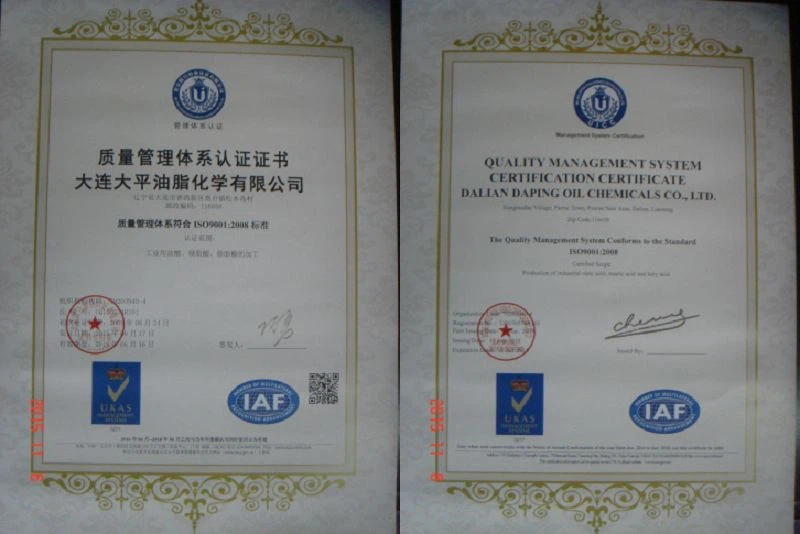
Our Factory
Our corporation was established in 1988 and it's a large-scale private enterprise specializing in production, processing, research and development of soybean oil chemicals. With a history of 30 years on oil industry from 1988 to 2018, it enjoys great reputation in the industry. With business increase of the enterprise and its increase in market share it prossesses, we established a new morden garden-type factory at Dalian chemical garden with the investment capital of RMB100,000,000.- in 2007. The new factory covers are area of 77,000m2 and has almost 200 employees.

Ultimate FAQ Guide to Tallow Distilled Fatty Acid
We're one of the most professional tallow distilled fatty acid manufacturers in China. If you're interested in tallow distilled fatty acid, please be free to check price and quotation with us. Also, free sample is available.
tallow fatty acid for asphalt modifiers, tallow fatty acid for mining industry, tallow fatty acid for oilfield chemicals-
![Feeder Grade Palmitic Acid]() Feeder Grade Palmitic AcidPalmitic acid is a high-energy substance that undergoes β-oxidation in animals to release substantial energy. It servesread more
Feeder Grade Palmitic AcidPalmitic acid is a high-energy substance that undergoes β-oxidation in animals to release substantial energy. It servesread more -
![Anti Gel For Diesel Fuel]() Anti Gel For Diesel FuelDescription:Vegetable BaseAppearance:LiquidProduct Summery:FAC producted through hydrolysis, distillation and otherread more
Anti Gel For Diesel FuelDescription:Vegetable BaseAppearance:LiquidProduct Summery:FAC producted through hydrolysis, distillation and otherread more -
![Best Anti Gel Diesel Fuel Additive]() Best Anti Gel Diesel Fuel AdditiveDescription:Vegetable BaseAppearance:LiquidProduct Summery:FAC producted through hydrolysis, distillation and otherread more
Best Anti Gel Diesel Fuel AdditiveDescription:Vegetable BaseAppearance:LiquidProduct Summery:FAC producted through hydrolysis, distillation and otherread more -
![Anti Gel Diesel Additive]() Anti Gel Diesel AdditiveDescription:Vegetable BaseAppearance:LiquidProduct Summery:FAC producted through hydrolysis, distillation and otherread more
Anti Gel Diesel AdditiveDescription:Vegetable BaseAppearance:LiquidProduct Summery:FAC producted through hydrolysis, distillation and otherread more -
![Diesel Fuel Supplement Cetane Boost]() Diesel Fuel Supplement Cetane BoostDescription:Vegetable BaseAppearance:LiquidProduct Summery:FAC producted through hydrolysis, distillation and otherread more
Diesel Fuel Supplement Cetane BoostDescription:Vegetable BaseAppearance:LiquidProduct Summery:FAC producted through hydrolysis, distillation and otherread more -
![Hot Shots Diesel Anti Gel]() Hot Shots Diesel Anti GelDescription:Vegetable BaseAppearance:LiquidProduct Summery:FAC producted through hydrolysis, distillation and otherread more
Hot Shots Diesel Anti GelDescription:Vegetable BaseAppearance:LiquidProduct Summery:FAC producted through hydrolysis, distillation and otherread more