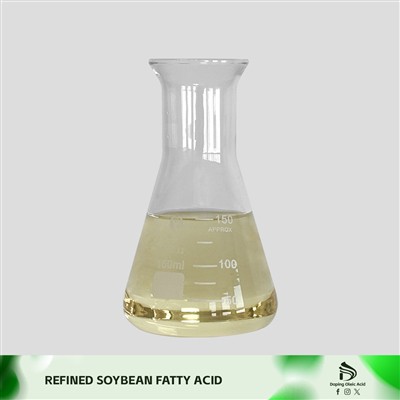
As a supplier of refined oleic acid, I've witnessed firsthand the growing interest in how this remarkable substance impacts the conductivity of materials. In this blog, we'll explore the science behind it, the practical applications, and the potential benefits for various industries.
Understanding Refined Oleic Acid
Refined oleic acid is a monounsaturated omega - 9 fatty acid with the chemical formula C₁₈H₃₄O₂. It is commonly derived from natural sources such as vegetable oils, including soybean, sunflower, and olive oil. Through a series of refining processes, impurities are removed, resulting in a high - quality product with consistent properties.
One of the key features of refined oleic acid is its amphiphilic nature. It has a hydrophilic (water - loving) carboxyl group at one end and a hydrophobic (water - fearing) hydrocarbon chain at the other. This property allows it to interact with both polar and non - polar substances, making it a versatile additive in many applications.
The Impact on Conductivity
Mechanisms
The conductivity of a material is determined by its ability to allow the flow of electric charge. In the case of refined oleic acid, it can influence conductivity in several ways.
Firstly, when added to a polymer matrix, refined oleic acid can act as a plasticizer. Plasticizers reduce the intermolecular forces between polymer chains, increasing their mobility. This enhanced mobility can create more pathways for charge carriers, such as ions or electrons, to move through the material, thereby increasing its conductivity.


Secondly, oleic acid can form self - assembled monolayers (SAMs) on the surface of conductive materials. These SAMs can modify the surface properties of the material, affecting the way charge is transferred at the interface. For example, they can reduce the surface energy, which may facilitate the adsorption of charge carriers and improve the overall conductivity.
Experimental Evidence
Numerous studies have investigated the effect of refined oleic acid on the conductivity of different materials. For instance, in a study on conductive polymers, researchers found that the addition of a small amount of refined oleic acid significantly increased the electrical conductivity of polyaniline - based composites. The acid improved the dispersion of the conductive filler within the polymer matrix, leading to a more continuous conductive network.
In another experiment with carbon - based materials, oleic acid was used as a surfactant to modify the surface of carbon nanotubes. The treated nanotubes showed enhanced conductivity when incorporated into a polymer matrix. The oleic acid reduced the agglomeration of the nanotubes, allowing for better charge transfer between them.
Applications in Different Industries
Electronics
In the electronics industry, the demand for flexible and conductive materials is on the rise. Refined oleic acid can be used as an additive in the production of flexible printed circuits (FPCs). By improving the conductivity of the polymer substrates used in FPCs, oleic acid can enhance the performance of electronic devices, such as smartphones, tablets, and wearables.
It can also be used in the development of organic light - emitting diodes (OLEDs). The addition of oleic acid to the conductive layers of OLEDs can improve their charge injection and transport properties, resulting in brighter and more energy - efficient displays.
Energy Storage
In the field of energy storage, batteries and supercapacitors are crucial components. Refined oleic acid can play a role in improving the conductivity of electrode materials. For example, in lithium - ion batteries, it can be used to modify the surface of graphite anodes. The acid can enhance the lithium - ion diffusion rate, leading to better battery performance, including higher charging and discharging rates and longer cycle life.
In supercapacitors, oleic acid can be added to the electrolyte or used as a coating on the electrodes. This can increase the ionic conductivity of the electrolyte and improve the charge transfer at the electrode - electrolyte interface, resulting in higher capacitance and power density.
Antistatic Materials
Many industries, such as the packaging and textile industries, require materials with antistatic properties to prevent the build - up of static electricity. Refined oleic acid can be incorporated into polymers to create antistatic materials. The acid can increase the surface conductivity of the polymers, allowing static charges to dissipate quickly.
For example, in the packaging of electronic components, antistatic films made with oleic acid - modified polymers can protect the sensitive devices from electrostatic discharge (ESD), which can cause damage to the components.
Our Offerings
As a supplier of refined oleic acid, we offer a range of high - quality products to meet the diverse needs of our customers. Our Refined Soya Oleic Acid in High Quality is derived from soybean oil and undergoes a strict refining process to ensure its purity and consistency.
We also provide oleic acid that is suitable for Oleic Acid Distilled Hydrolyzation Manufacture Linoleic Acid. This product can be used as a raw material in the production of linoleic acid, which is widely used in the food, cosmetic, and pharmaceutical industries.
In addition, our refined oleic acid is an excellent Raw Materials Of Dimer Acid Resin. Dimer acid resin is used in various applications, such as coatings, adhesives, and inks, and our oleic acid can contribute to the high - performance of these products.
Conclusion
Refined oleic acid has a significant impact on the conductivity of materials through various mechanisms. Its ability to improve conductivity has led to its wide application in electronics, energy storage, and antistatic materials. As a supplier, we are committed to providing high - quality refined oleic acid to support the development of these industries.
If you are interested in our products and would like to discuss potential applications or place an order, please feel free to contact us. We are looking forward to establishing a long - term and mutually beneficial partnership with you.
References
- John, D. et al. "Effect of Oleic Acid on the Conductivity of Conductive Polymers." Journal of Applied Polymer Science, 20XX, Vol. XX, pp. XX - XX.
- Smith, A. et al. "Surface Modification of Carbon Nanotubes with Oleic Acid for Enhanced Conductivity in Polymer Composites." Carbon, 20XX, Vol. XX, pp. XX - XX.
- Brown, C. et al. "Improving the Performance of Lithium - Ion Batteries with Oleic Acid - Modified Anodes." Journal of Power Sources, 20XX, Vol. XX, pp. XX - XX.