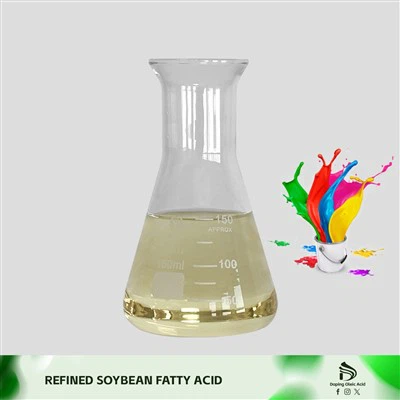
IV120 soybean fatty acid is the undisputed workhorse of our Dalian distillation line, and by far our highest-volume grade year in and year out. If you've worked with industrial fatty acids for any amount of time, you've almost certainly run into this exact cut somewhere in your supply chain. It's not the fanciest grade we make, it's not the highest iodine value, and it's not marketed as some "premium specialty solution" with a jacked-up price tag. It's just the most practical, most forgiving, most broadly useful cut we produce, and it's the one we recommend to anyone who doesn't have a very specific reason to reach for something higher or lower.
It comes off the exact same fractionation column as our IV140 grade - the only real difference is where we make the cut along the column. IV120 pulls a slightly heavier, more balanced fraction that lands right in the middle of the reactivity spectrum. It's not hot, it's not slow. It's just steady. We've been running this exact cut for well over a decade, and it ships on a regular schedule to customers all across domestic China, Southeast Asia, Europe, the Middle East, and even parts of Africa. It feeds alkyd resin plants, dimer acid reactors, surfactant blending lines, rubber compounding operations, and a dozen smaller niche industries. If there's a standard industrial process that uses soy fatty acid, odds are IV120 will work for it.
Let's start with feedstock, because that's where consistency really starts, and there's no reason to dress it up. We use 100% non-GMO crude soybean oil for every grade on this line, IV120 included. And let's be completely honest about why we made the switch. It wasn't some grand sustainability strategy we dreamed up to win marketing awards. It wasn't a top-down decision from management to "go green" and charge more for it.
It started gradually, going back to the late 2000s with a handful of European customers who needed non-GMO source material to meet their import regulations and end-market labeling requirements. Then around 2016, it picked up fast - more European buyers, then Southeast Asian customers, then even some domestic Chinese manufacturers that exported their own finished goods started asking for it. Within a couple years, we had switched the entire line over to non-GMO feedstock full time, and we've never looked back. No upcharge. No greenwashing press releases. No "eco-premium" added to the price. It's just our standard feedstock now, because that's what our customers need to stay compliant in their markets.
We also don't outsource any part of the refining process, which is a bigger deal than a lot of buyers realize. There are plenty of suppliers in this industry that buy pre-hydrolyzed crude fatty acid from a third-party refinery, run it through one quick polishing distillation step, and slap their own label on the drum. That's not how we operate.
Every single step of the process happens right inside our Dalian facility. Raw oil receiving and incoming inspection. Hydrolysis. Primary bulk distillation. Fine fractional distillation. Final filtration. Even drum filling, palletizing, and container loading. We do it all in house. That means we control every critical specification directly - iodine value, acid value, moisture, color, trace impurities, you name it. We don't have to take a third party's word for what's in the material. If something starts to drift off spec, our lab and our production team catch it while the batch is still in the production tank, not after it's loaded onto a container ship and two weeks out from port. That's the difference between a minor process adjustment and a very expensive logistics headache for you.
Straight off the distillation column, IV120 consistently lands between 118 and 122 g I₂/100g. We don't advertise a perfect, dead-on "120" on every certificate of analysis, because that's simply not how large-scale industrial distillation works in the real world. Anyone who tells you their product hits an exact single iodine value every single batch, without exception, is either running 50-liter lab batches that don't scale to full tankers, or they're not being straight with you. Industrial fractionation works in ranges, not fixed digits. Any supplier worth doing business with will tell you that upfront.
We hold that tight 4-point window not with some flashy AI-powered automated control system that tunes itself every second and spits out optimization reports, but with actual human beings paying close attention, shift after shift. The lead operator on this column has been on this exact line since we first installed it back in 2011. That's over 13 years running the same piece of equipment, day in and day out. He knows it inside and out.
He checks iodine value and key temperature points twice every shift, but he doesn't just rely on the gauges. He can tell how the material is running just by looking at the flow through the sight glass. He can hear a subtle change in the vacuum pump that tells him something's off before the control panel even throws an alert. When the feedstock composition shifts a little - and it always does, with every new tanker of crude oil, or even when the plant cools down overnight on a cold winter night - he tweaks the cut point and reflux ratio by hand, early, before the numbers drift far enough to matter.
You can call it hands-on precision control if you want. We just call it doing the job properly. It's not high technology. It's experience. It's attention to detail. It's not cutting corners on staffing so one overworked operator is juggling six different columns at once.
In terms of actual chemical composition, unsaturated fatty acids make up roughly 85% of IV120, mostly linoleic acid and oleic acid, with a small share of linolenic acid. Is this some custom, lab-engineered fatty acid profile we invented in an R&D center to deliver "optimized performance"? No. That's just the natural makeup of soybean oil, separated and concentrated at this particular distillation cut.
Our job isn't to reinvent the chemistry of soybean oil. Our job isn't to engineer some fancy new molecular profile that doesn't exist in nature. Our job is to strip out the impurities, make a clean, sharp fraction cut, and keep that composition consistent batch after batch after batch. That's what you're paying for - reliability, not miracles. Consistency, not marketing buzzwords.
Saturated fatty acid content stays low across the grade, so the material stays a clear, light golden, pourable liquid at normal room temperatures. It pours evenly, pumps smoothly through standard transfer lines, and doesn't drop unexpected solids into your reactor. For most production facilities in moderate climates, you won't need to pre-heat drums before unloading, which saves a little time and energy on your end and cuts down on handling hassle. If you're running a plant in a very cold climate in winter, it might thicken up a little, but a mild, quick warm-up is all it takes to get it flowing again. No hours of pre-heating like you'd need with a higher-saturation product.
Now let's talk about where this grade actually shines, and who it's right for.
First and probably biggest use case: alkyd resin production. IV120 is the go-to standard for medium-oil alkyd formulations and general industrial coatings. This is the sweet spot for most resin makers. Cure speed is faster than lower IV grades like IV100, but slower and much more controllable than higher grades like IV140. What you get is predictable cure speed - not "blazing fast" cure speed. There's a big difference.
It delivers a really solid balance of hardness and flexibility in the final film, with reliable adhesion and decent outdoor weathering resistance. It works well across almost every general industrial coating application: general industrial topcoats, anti-rust primers, wood coatings, architectural finishes, even some agricultural equipment paints. It's the most forgiving grade to formulate with, especially if you're running a high-volume line where consistency matters more than absolute peak performance.
We have a large domestic industrial paint manufacturer that's been using this exact IV120 grade in their primer line for almost six years now. They dialed their formula in once, back in 2018, and they've barely touched it since. They don't have to re-verify every new batch. They don't have to tweak drier levels every other month because the iodine value shifted. It just works. That's the value of consistent raw material.
That said, we're not going to tell you switching to our IV120 will magically make your coating 20% better or solve every problem on your line. Formulation is a whole system. Your resin backbone, your pigment package, your driers, your additives - all of those matter far more than the fatty acid alone. What we will promise is that it will perform consistently. Once you get your formula dialed in, it will stay dialed in. If you're currently fighting batch-to-batch inconsistency from your current supplier, this will feel like a huge upgrade. If you need ultra-high performance for a specialty high-end coating, you'll need to adjust more than just your fatty acid.
Second big application: dimer acid production. For manufacturers making general-purpose dimer acid for adhesives, sealants, and curing agents, IV120 is the standard reliable choice. It's reactive enough to drive solid conversion rates, but not so hot that the reaction runs away from you and generates extra byproducts that drag down final purity and yield. The reaction window is wider and more forgiving, which makes it much easier to run steady production without constant catalyst adjustments and process tweaks.
We have a long-running customer in Malaysia that makes dimer acid for the regional adhesive market, and they've been using this exact grade for about three and a half years now. They only adjust their catalyst loading once every quarter, mostly to account for seasonal temperature swings in their plant, not because our product is shifting batch to batch. They called it "boringly consistent" once. That's still the highest compliment we've ever gotten for an industrial raw material. Your job is to keep your production line running. Our job is to make sure our material never gives you a reason to stop and troubleshoot.
Third major use: industrial surfactants and bio-based detergent formulations. The C18 unsaturated chains in IV120 deliver solid, balanced emulsifying power and moderate foaming, which works perfectly for heavy-duty industrial cleaners, metalworking fluids, and general-purpose plant-based household detergents. It's REACH compliant, fully biodegradable, and fits right into formulations marketed as renewable or plant-based.
It's not the absolute highest-performing surfactant feedstock on the market - there are more specialized, much more expensive options for that - but it's a cost-effective, reliable workhorse that hits the mark for 90% of standard formulations. Most buyers don't need the ultra-premium stuff. They need something that works, that's consistent, and that doesn't blow up their raw material budget. That's IV120.
You'll also find it used in rubber processing aids, where it improves compound flow and mold release while supporting good aging resistance. It works great for general-purpose rubber goods like hoses, belts, and seals. If you're formulating specialty high-performance rubber with extreme service requirements, run a compatibility trial first. We're not going to tell you it works with everything. That's just not honest.
There are a handful of smaller niche applications too. It goes into leather fatliquoring agents to soften grain and improve feel. It's used as a raw material for certain lubricant additives and corrosion inhibitors. Some mining operations use it as a component in flotation collectors. It even works as a co-feedstock for certain plasticizers and processing aids in engineering plastics. We don't claim it's perfect for every single one of these uses. But for most standard industrial uses, it does exactly what you expect it to.
Now let's talk about the actual numbers you'll see on a real certificate of analysis, not the polished marketing brochure version. No fluff, just reality.
Acid value typically runs between 195 and 205 mg KOH/g, give or take a few points. Is it exactly 200 every single batch? No. No large-scale industrial distillation process is that perfectly consistent. If your formulation is so sensitive that a 3 or 4 point swing in acid value will break it, you've probably got bigger issues to work through on your end. A robust formulation is built to handle normal industrial variation.
Moisture content for IV120 stays under 0.3% almost all the time. That's not thanks to some patented super-drying technology or fancy molecular sieve system. It's because we maintain our vacuum pumps on a strict schedule, we pull a consistent deep vacuum during distillation, and we don't skip scheduled equipment maintenance to save a quick buck. When your vacuum system is tight and well cared for, moisture doesn't leak back into the product. It's not rocket science. It's just basic plant discipline.
Color, measured on the Gardner scale, usually falls between 2 and 4 for standard production, and stays within about two points across a single batch. Usually. If you need consistently lighter color - Gardner 1 or below - let us know before you order. We can segregate lighter batches and hold them for you, but it will cost more and take longer to put together a full shipment. We don't advertise "ultra-low color" as a standard feature at a standard price. That's misleading. This is industrial material. Sometimes color runs a little darker, depending on the feedstock. When it does, we tell you upfront, not try to slip it past you.
Packaging options are straightforward. We have standard 180kg PE-lined steel drums, 940kg IBC totes for intermediate bulk, flexitanks for container shipments, and full bulk tanker shipments for high-volume regular customers. For export orders, a 20ft full container usually loads 16 to 18 metric tons, depending on which packaging option you go with.
Standard lead time for spot orders is 10 to 15 days after order confirmation. If you're on a regular contract with steady monthly volumes, we build our distillation schedule around your delivery windows, so lead times are shorter and pricing is better. That's how it should work for regular buyers - you commit to consistent volume, we commit to priority production and better rates. It's a two-way street.
Samples come straight from current production runs. We can send 1kg, 5kg, whatever you need to run a full lab trial and a small production test. We don't keep a separate "sample grade" stock that's been specially processed to look better than the bulk material you'd actually order. That's a cheap trick, and it always catches up to you eventually. What you test in your lab is exactly what will show up at your plant. No bait and switch. No fine print.
We're not the largest soy fatty acid manufacturer in China. We don't claim to have the most advanced technology or the absolute lowest prices on the market. There are suppliers out there that can beat us on price, if that's all you care about.
What we do claim is that we'll be straight with you.
If our IV120 is the right fit for your application, we'll tell you. If it's not - if you need a higher iodine value, or tighter specs, or a different feedstock entirely - we'll tell you that too. We won't waste your time with generic sales pitches about "premium quality" and "world-class service". We won't overpromise just to win an order.
When you call with a formulation problem or a question about a batch, you'll get someone who actually works with this product every day, not a sales rep reading off a script. Sometimes the answer is "try turning your reactor temperature up a couple degrees". Sometimes it's "that's probably not the fatty acid - let's walk through your process". Sometimes it's "you might actually be better off with our IV140 instead". But you'll get a straight answer, and you'll get it fast.
If you're tired of suppliers that overpromise and underdeliver, that ship off-spec material and then argue about it, that never pick up the phone when you have a problem, give us a try. Send us your specs, tell us what you're making, and we'll send you a sample and a straightforward quote.

| Item | Test Method | Qualified Value |
| Appearance | Visua | Liquid 25℃Conform |
| Colour(Fe-Co) | GB/T1722 | 3 Max |
| Acid Value(mgKOH/g) | GB/T9104.3 | 195-207 |
| Iodine Value(gl2/100g) | GB/T9104.1 | 120 Min |
| Saponification Value(mgKOH/g) | GB/T9104.2 | 196-208 |
| Solidifying Point(℃) | GB/T9104.5 | 30 Max |
| Moisture(%) | GB/T9104.6 | 0.3 Max |

Hot Tags: Soya fatty acid, China, manufacturers, price, quotation, free sample, hexadecanoic acid, fatty acid analysis, palmitic acid, stearic acid, organic fatty acid, eicosanoic acid