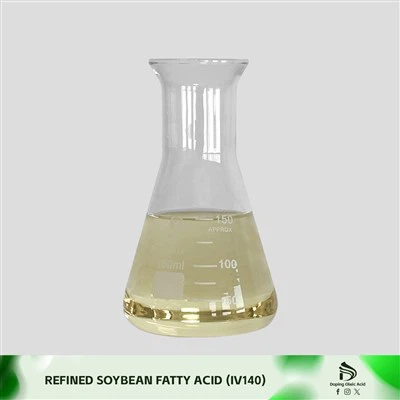
IV140 High-Iodine Soybean Fatty Acid
The production-grade reactivity upgrade that doesn't come with a specialty price tag
Anyone who's spent time formulating industrial coatings or running dimer acid reactors knows the unspoken rule of soybean fatty acids: higher iodine value means higher cost, smaller batches, and more headaches.
Plenty of suppliers will sell you 150+ g I₂/100g grades, polished to look perfect on data sheets and marketed as high-performance specialty materials. But scale that up to full production runs, and the math falls apart fast. You pay 30–40% more for marginal reactivity gains, fight wider batch-to-batch variation, and spend more downtime cleaning oligomer residue out of reactors and reworking off-spec material. Most manufacturers that want more reactivity end up playing it safe: they stick with mid-range grades and just push their process harder. More catalyst, longer hold times, higher oven temps. It works, but it's inefficient, it wears on equipment, and it only gets you so far.
IV140 is the gap most suppliers don't lead with. It's the highest iodine value cut we can pull consistently off a standard continuous fractionation column, at full production volume. No small-batch specialty runs, no premium markup for "high-performance" labeling. Just a clean, well-controlled high-iodine fraction that delivers meaningful reactivity gains, at production-grade consistency, for production-grade pricing.

The sweet spot where performance and scale actually meet
Here's the unglamorous truth about soybean oil fractionation: the higher you climb up the iodine value scale, the thinner the slice of the distillation curve you're cutting. Push past 145, and yield drops off sharply. You're trimming more and more material off both sides of the cut to hit a narrow high-IV window, which drives up cost, reduces output per run, and widens natural batch variation. Most ultra-high-IV grades aren't even run on continuous lines at all - they're small batch cuts, processed separately, which is exactly why they cost so much and ship so slow.
IV140 lands right before that drop-off. Held consistently between 138 and 142 g I₂/100g, it captures nearly all of the practical reactivity benefit of higher unsaturation, but it still comes off our main continuous fractionation column, at full volume, with all the consistency and cost efficiency of a standard production grade.
You don't pay a specialty premium. You don't wait weeks for a custom production slot. You get a meaningful step up in reactivity, off a standard production line. For plant managers and formulators watching both output and cost, it's the point on the spec curve where the math actually works.
Consistency comes from operators who know the column, not just algorithms
We run full DCS monitoring across every fractionation column - temperatures, pressures, flow rates, vacuum levels, all logged 24/7. But when it comes to holding that 138–142 window tight run after run, the final call doesn't come from an algorithm. It comes from the production floor.
Crude soybean oil composition shifts a little with every tanker delivery. Overnight temperature swings and humidity shifts nudge the thermal balance inside the column. Most of these are tiny, temporary blips. Automated control systems react to every single one, tweaking reflux ratios and cut points constantly, and more often than not, they end up creating bigger swings than they fix. They chase noise, and turn small natural variations into actual product drift.
The team running this line has been working this exact column for over 15 years. They do a full walkdown every two hours, and they don't just stare at gauge screens. They watch the flow through the sight glass - the clarity, the way it breaks at the edge. They listen for subtle shifts in the vacuum pump tone that signal a change before the digital sensors pick it up. They know which blips are just noise and which ones are the early start of an actual drift.
We pull formal lab samples every four hours, of course. But more often than not, the lead operator has already made a small, gentle adjustment by the time the results come back. That's how you hold consistency tight at production scale. Not with more sensors. With people who know the process well enough to leave it alone when it's running right.
Non-GMO traceability is standard, not an upgrade
Every drop of IV140 comes from 100% non-GMO crude soybean oil, same as every grade on this dedicated production line.
Let's be honest: this isn't some "sustainability initiative" we dreamed up to charge a premium. We switched the entire line over close to a decade ago because European and then Southeast Asian customers started requiring full traceability for import clearance, REACH registration, and end-product labeling. We didn't do a partial conversion. We didn't run GMO and non-GMO on alternate runs. We switched the whole line fully, and we've never gone back.
That means no cross-contamination risks, no split production runs, no gray areas on origin. Every drum can be tracked back through production to the exact crude oil shipment it came from. It's not a paid add-on. It's not a marketing bullet point. It's just how we run the line.
We also don't buy pre-hydrolyzed crude fatty acid from third-party refineries and run it through a quick polish step. Every stage - hydrolysis, primary distillation, fractional cut, final filtration, even drum filling - happens on site at our Dalian facility. We control every step, so we own every spec. If something starts to drift, we catch it while the batch is still in the production tank, not after it's loaded onto a container and two weeks out to sea.
Where it moves the needle on your production floor
IV140 delivers real, measurable value across a range of high-volume industrial applications.
High-solids, low-VOC alkyd coatings
If you've been through a low-VOC reformulation project, you know how painful it is. You cut solvent to hit emissions targets, and suddenly cure speed falls off a cliff. You start piling on more driers, you run into yellowing issues, and before you know it you're rebuilding the whole formulation from scratch.
IV140 is the easiest shortcut most formulators never think of. The higher density of reactive double bonds drives faster crosslinking even at higher solids levels, so you can pull solvent out of your formula without giving up line speed.
One architectural coating customer in the Gulf went through this exact scenario two years ago. They needed to cut VOC content to meet new municipal regulations, and their standard IV120-based formula was curing far too slow once they raised solids. They tried adding more driers first, but yellowing became unacceptable on white exterior grades. Switching to IV140 let them raise solids by 10 percentage points, hit the VOC target, and keep their original line speed - with only a minor adjustment to their cobalt drier level. No full reformulation, no months of testing, no production shutdowns for line trials. Just a raw material swap that solved most of the problem.
Dimer acid for adhesives and curing agents
For dimer acid producers, IV140 hits that ideal balance of fast conversion and controlled reaction. Lower iodine grades mean longer reaction times and lower yield per batch. Push too high, and you get runaway polymerization, piles of oligomer byproducts, and more time and energy spent on downstream purification.
With IV140, the density of double bonds is high enough to drive solid conversion rates, but not so high that the reaction gets away from you. Byproduct formation stays low, yield stays high, and operators don't have to camp out by the reactor tweaking catalyst loading every shift.
A dimer acid manufacturer in northern China that supplies the wood adhesive industry switched to IV140 about three years ago. They'd been running a mid-range grade and fighting consistent yield issues. Since switching, they've seen roughly 6% higher yield per batch, and oligomer content dropped by almost a quarter. Catalyst adjustments went from weekly to quarterly. The reaction just runs steady.
High-speed coil and container primers
For high-speed coil coating and container shop primer lines, IV140 solves a common pain point: mid-iodine grades can't keep up with line speed, and higher specialty grades cause surface skinning and pinholing.
IV140 cures fast enough to handle elevated line speeds without tack-off issues, but crosslinking progresses evenly through the film thickness. You don't get that dry-skin-over-wet-bottom effect that causes defects and hurts long-term adhesion. The finished film hits a good balance of hardness and flexibility, so it holds up through forming and stamping operations without chipping.
Heavy-duty metalworking fluids
It also performs well in semi-synthetic metalworking fluids. The higher unsaturation creates a stronger, more durable adsorbed film on metal surfaces, which delivers better load-carrying capacity and improved corrosion protection compared to mid-iodine grades. It works particularly well in cutting and grinding fluids where extreme pressure performance matters, and it is fully biodegradable for compliance with environmental discharge rules.
Real-world specs, no marketing rounding tricks
These are typical production ranges, not idealized lab numbers. If you've worked in this industry long enough, you know the difference.
Iodine value: 138 – 142 g I₂/100g. It will never be a perfect 140 every single batch. Continuous industrial fractionation doesn't work that way. If you need a tighter 139–141 window, we can do it - but it will cost more, because we have to trim more material off both sides of the cut to hit that narrow range. For 95% of production applications, the standard range is more than enough.
Acid value: 195 – 205 mg KOH/g, with normal variation of a few points either way. No large-scale distillation process hits an exact 200 every run. If your formulation breaks over a 3-point swing, the issue is almost always formulation robustness, not the raw material.
Moisture: < 0.1% under normal production conditions. No patented drying technology, no fancy molecular sieves. Just well-maintained vacuum systems and consistent deep vacuum during distillation. Basic plant discipline, nothing more.
Color (Gardner): Typically 2 – 4, with no more than 2 points of variation within a single batch. If you need consistently lighter color - Gardner 1 or below - we can segregate lighter-cut batches for you. But it costs more and takes longer, for obvious reasons. We don't advertise "ultra-light color" as a standard feature. That would be misleading.
Packaging, lead times, and samples
Packaging options: 180kg PE-lined steel drums, 940kg IBC totes, and flexitanks for full-container sea shipments. A 20ft FCL loads roughly 16 – 18 metric tons, depending on packaging selection.
Lead time: This is a regular production grade, so spot orders typically ship in 10 – 15 business days. For customers on annual volume contracts, we reserve dedicated production slots. That means shorter, more predictable lead times, and stable pricing even when markets get tight.
Samples: We can supply 1kg, 5kg, or larger sizes for lab evaluation and small-scale trials. All samples are pulled straight from full production runs - not from separate lab batches tweaked to look lighter or hit perfect specs. What you test is exactly what you'll get in bulk. No bait and switch.
IV140 isn't the highest iodine value fatty acid on the market. If you're working on a niche aerospace coating or a high-performance specialty polymer and need 150+ IV, there are better options out there. They'll just cost you a lot more, and you'll wait a lot longer for them.
But if you're running production at scale, and you want more reactivity than a standard mid-range grade can give you - without paying specialty prices, without fighting batch-to-batch variation, without rebuilding your entire formulation - IV140 is the sweet spot.
It's not flashy. It doesn't come with fancy marketing claims. It's just a solid, well-made, production-grade high-iodine fatty acid that does what it says, batch after batch.
If you've been pushing mid-range grades as far as they'll go, and you're ready for a step up without the headache, get in touch. We'll send over a sample and a straightforward quote.
| item | method | SPEC. | Result | Individual Judgment |
| Product form | Visual | liquid 25℃ | Confirm | pass |
| Colour (Fe-Co) | GB/T1722 | 4max | 3 | pass |
| Acid value (mgKOH/g) | GB/T 9104.3 | 195-209 | 197.4 | pass |
| Iodine value (gI2/100g ) | GB/T 9104.1 | 140min | 143.7 | pass |
| Saponification value (mgKOH/g) | GB/T 9104.2 | 196-208 | 198.6 | pass |
| Titre (℃) | GB/T 9104.5 | 19max | 20.3 | pass |
| Moisture (%) | GB/T 9104.6 | 0.3max | 0.02 | pass |
| C12+C14 (%) | GB/T 9104.9 | 1max | - | pass |
| C16 (%) | 8max | 2.1 | pass | |
| C18 (%) | 6max | 5.1 | pass | |
| C18' (%) | 20-35 | 26.7 | pass | |
| C18'' (%) | 54-60 | 58.2 | pass | |
| C18''' (%) | 8max | 5.3 | pass | |
| Others (%) | - | 2.6 | pass |
FAQ:
Q: What is the difference between soybean oil fatty acid and common mixed vegetable fatty acid?
A: Soybean oil fatty acid adopts pure soybean-based raw materials with stable composition and negligible batch difference. It has fewer impurities and better consistency than ordinary blended mixed fatty acid. It provides higher cost performance while maintaining stable industrial performance.
Q: Is this product food grade or industrial grade?
A: Our standard product is industrial grade only. It is not applicable for food processing, food contact or edible usage. It is widely used in chemical, plastic, coating, textile and daily chemical industries.
Q: What are the key specifications of your soybean oil fatty acid?
A: The core regular indexes are as follows:
- Acid Value: 190–205 mgKOH/g
- Saponification Value: 192–208 mgKOH/g
- Iodine Value: 120–140 g/100g
- Color (Gardner): ≤3
- Moisture: ≤0.5%
All indexes can be customized according to customer requirements.
Q: Is your product stable in different seasons?
A: Yes. Our products are produced with fixed distillation technology, with strict batch testing. The color, acid value and iodine value remain stable in high-temperature summer and low-temperature winter, avoiding quality fluctuation.
Q: Will the product freeze or solidify in cold weather?
A: As a natural plant mixed fatty acid, it will turn slightly turbid or semi-solid in low temperature (below 10°C). This is a normal physical phenomenon and will not affect chemical performance and final usage.
Q: What industries is soybean oil fatty acid used for?
A: It is widely applied in:
- Emulsifiers and surfactants
- Soap and daily detergent production
- Rubber and plastic additives
- Paint, coating and resin industry
- Grease and metal processing fluids
Q: Can it replace tall oil fatty acid or oleic acid?
A: In most conventional industrial formulas, it can perfectly replace general tall oil fatty acid and common vegetable oleic acid with lower cost and better stability. We can provide formula suggestion based on your production process.
Q: What is your standard packaging?
A: Standard packing: Flexitank/180KG iron drum / plastic drum.
Flexible packing such as IBC tank (1000KG) is available upon request.
Q: Is FCL and LCL shipment available?
A: Both FCL and LCL are supported. We have stable stock and can arrange fast delivery for small trial orders and bulk orders.
Q: What is your loading port?
A: Main loading ports: Dalian Port,. We can arrange shipment according to your designated port.
Q: What certificates can you provide?
A: We can provide COA (Certificate of Analysis), MSDS, Commercial Invoice, Packing List, and Bill of Lading.
Q: Do you support customized specifications?
A: Yes. We can adjust color, acid value, iodine value and purity range according to customers' specific production needs.
Q14: What is your monthly production capacity?
A: Our monthly production capacity reaches 800–1000 tons, ensuring stable and continuous bulk supply for long-term clients.
Q: Do you accept trial orders?
A: Yes. Small trial orders are warmly welcomed to test our quality and market suitability.
Q: What is your delivery lead time?
A: For spot goods: 3–7 days after receiving deposit.
For bulk customized orders: 7–15 days.
Q: How do you guarantee after-sales quality?
A: Every batch is tested before delivery with official COA. If any quality problem caused by our production, we promise full refund or replacement.
Q: Is your product eco-friendly and biodegradable?
A: Yes. It is refined from pure plant-based raw materials, with low pollution and good biodegradability, compliant with most industrial environmental standards.
Q: Do you support ISCC certification?
A: Yes, we can provide ISCC EU certified soybean oil fatty acid for customers with sustainable raw material requirements.
Hot Tags: china second largest manufacture for soya fatty acid, China, manufacturers, price, quotation, free sample, manufacturing application of oleic acid, chemical fatty acid, oleic acid for plastic industry, manufacturing fatty acid, high iodine value oleic acid for textile industry, oleic acid in textile industry production